

The Librarian's Library Card Had a Wait List. Her Little Glass Bottle Did Too.
MaryRuth's Organic Lion's Mane is a dropper, not a capsule — USDA organic, alcohol-free, one milliliter a day in anything you're already drinking. No capsules, no swallowing contest. I read the label first.

First, the people: June Calloway is a pen name, and Evelyn from this story is a composite of two librarians and one retired schoolteacher, the way small-town columns have always worked.
Everything here about the drops comes from the seller's own listing, its label, its published ingredient page, and its verified reviews, all read in October 2026.
The Small Town Dispatch does not sell supplements. We read labels out loud at the kitchen table, print what we find, and let the county make up its own mind.
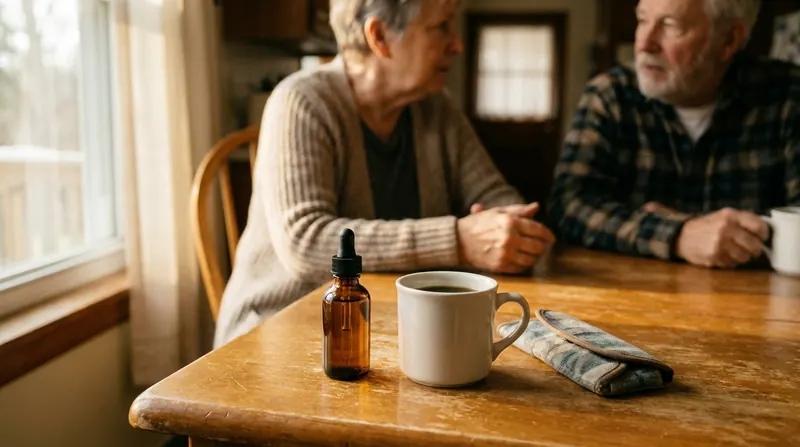
The Bath County library ran on two things: donated paperbacks and Evelyn's morning routine.
Evelyn Carr — thirty-four years behind the front desk, keeper of the reading glasses jar, first name basis with every overdue book in three zip codes — retired in March.
The retirement lasted eleven days.
By the twelfth, she was volunteering Tuesdays, shelving with the speed of a woman who knows exactly where everything goes, and complaining — cheerfully, constantly — about one thing: her weekly capsule organizer.
"I have spent thirty-four years alphabetizing," she told the front porch circle in April. "I refuse to spend retirement organizing capsules by day of the week."
Her daughter had sent her a bottle of capsules from the big-box store. The bottle was plastic, the capsules were enormous, and the label — in Evelyn's telling — "listed forty things, forty of them unpronounceable, none of them from any plant my mother ever grew."
She was still complaining about it in May when the quilt guild's spring sale brought in a vendor's daughter from two counties over, who mentioned, in the way people mention things at quilt sales, that her mother had switched to drops.
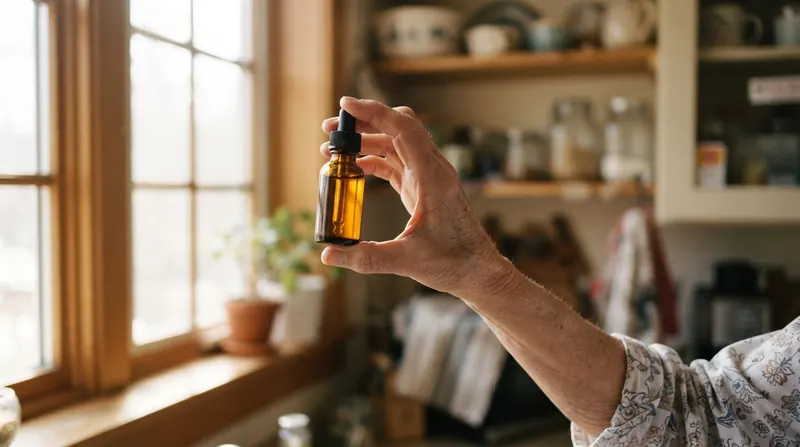
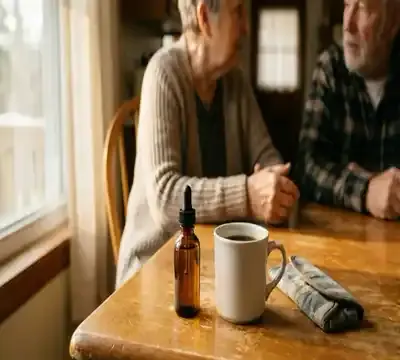
A little glass bottle. A dropper with marks on it. One squeeze, once a day, in the coffee Evelyn was already drinking.
Evelyn, being a librarian, checked out the facts before she checked out anything else.
This column is about what she found: the label, the company, the reviews, and the Tuesday morning in October when the porch circle finally got to taste — well, not taste, exactly, but witness — a dropper at work.
The Bottle, Catalogued
Evelyn catalogs things the way other people breathe, so let us catalog the bottle.
Format: one fluid ounce, thirty milliliters, in glass — a real glass bottle, which mattered to Evelyn more than she expected. "The plastic one rattled like a box of worries. This one sounds like a jar of good jam."
The dropper: graduated, with marks at a quarter, a half, three-quarters, and a full milliliter. The label's serving is one milliliter, one to three times a day. Evelyn takes hers once, in the morning coffee, "because the coffee is non-negotiable and the dropper is agreeable."
The contents: organic lion's mane mushroom extract, in vegetable glycerin and water. Alcohol-free. USDA Organic, says the front, in the green seal, with the little USDA underneath it.
What is not in it: alcohol, gluten, GMOs, sugar. "A short list of absences," Evelyn calls it, "which is the best kind of list."
The taste: she describes it as "sweet, faintly planty, gone by the second sip." Her granddaughter describes it as "like pancake syrup studied botany." Both descriptions are accurate, which is the thing about families.
The Company, Checked Out Like a Book
A librarian does not trust a book she cannot trace to a publisher, and Evelyn does not trust a bottle she cannot trace to a company.
The trace, for the record, runs like this.
The maker is MRO MaryRuth, LLC, of 1171 South Robertson Boulevard, Los Angeles. There is a phone number on the listing — an actual phone number, answered, in her experience, by people — and an email that begins with "wecare."
The company is a family business. MaryRuth is a person, a mother, a certified health educator, and the brand's own story is hers, told plainly on the site. Evelyn read the story twice and pronounced it "a biography, not a myth," which from her is a rave.
The price is twenty-one ninety-five for the ounce. Evelyn's arithmetic — thirty servings to the bottle — makes it about seventy-three cents a day, "cheaper than the library's late fees used to be, and I ran those fees for thirty-four years."
And the guarantee: the company's standard return policy. Evelyn did not need it, but she checked it anyway, the way she checks references on every book order. It is there, in plain type, on the listing.
What Lion's Mane Is, in Plain Library Terms
The Dispatch's science shelf is a card catalog of honest sentences, and here are the cards for lion's mane.
It is a mushroom, white and shaggy, that grows on hardwood trees and looks exactly like its name. It has been food in Asia for centuries and an herbal tradition for most of those centuries.
The label calls it "traditionally used as a nervine" — an old herbalist's word for a plant taken for steadiness — and stops there. The card catalog appreciates the restraint.
The modern research file is small, active, and early. Studies in laboratories, studies in small groups, studies that the researchers themselves describe as preliminary. The headlines, as usual, run about ten years ahead of the file.
What no one has studied — and the Dispatch prints this sentence in every column like this one — is this bottle, this dose, this librarian, this coffee.
Evelyn's summary, delivered over the catalog desk: "The mushroom is traditional. The research is young. The bottle is honest about both. Next question."
There was, of course, a next question. There always is, on the porch.
The Tuesday the Porch Circle Tried It
The porch circle — four retirees, one wicker loveseat, and a standing agreement that anything one of them endorses gets sampled by all of them, "like a jury with rocking chairs" — convened on a Tuesday in early October.
Evelyn brought the bottle. The Dispatch, by invitation, brought a notebook.
The demonstration took ninety seconds: shake gently, unscrew, squeeze to the top mark, swirl into the coffee.
The verdicts, in seating order:
Dot, 71, retired postmaster: "Tastes like almost nothing. I've had tap water with more personality. I mean that as a compliment."
Marv, 68, retired ag teacher: "It's sweet. Not syrup-sweet. Like the idea of syrup." Marv then asked three questions about the glycerin, which were answered from the label, which Marv read aloud in full, because ag teachers do not change after retirement.
June, 69, this columnist, present in disguise: "The dropper has the measurement printed on the glass. I have waited my whole life for a kitchen tool that tells the truth."
Evelyn, 70, host and instigator: "Four for four. The circle has spoken. Somebody write that down; there's a newspaper here."
The newspaper wrote it down. The circle then adjourned to the crossword, the church potluck schedule, and whether the new stop sign on Route 4 is "a scandal or a menace," which remains the porch's longest-running unresolved question.
The Reviews, Read the Way a Librarian Reads
The listing carries its reviews through Okendo, a review platform, and the Dispatch counts what is actually countable rather than what sounds good on a page.
The count: twenty-five reviews, when we read them, averaging 4.9 stars, marked verified. A small wall — not sixteen hundred, not a hundred — and the column prints the number plainly because a small honest wall beats a big unaudited one.
The five-star shelf:
Sallie F., verified: "Taken as recommended, this product does well for me." Short, unspectacular, and — the Dispatch notes — the most common shape of an honest review.
Missy T., verified: "Uses top tier ingredients, worth the price point. I used an off brand before and I felt like it was having a reverse effect cognitively speaking." TheDispatch prints it as written, including the reviewer's own hedge, which the reviewer's own italics would carry if Okendo allowed italics.
Erinn R., verified: "I got this since I can no longer get the powder I was using before and these drops are just as good for helping me focus at work. I love them!"
The four-star shelf, printed because the Dispatch prints shelves, not highlights:
Tyra S., verified, four stars: "Bottles are too small for the amount required to take daily and don't last a whole month. I feel like the product could be good if didn't run out so soon and have to reorder so often." Evelyn's note on this one: "Valid. I buy two at a time now. The card catalog called it 'a supply-chain complaint, not a product complaint,' and the catalog is right."
And the three-star shelf, because a review wall with no bad days is an advertisement, and this is a newspaper:
Cindy M., verified, three stars: "Too sweet for me, does it come in capsules instead." The irony, the porch noted, is structural: the bottle exists precisely because some people cannot or will not take capsules. Taste, like retirement, is a matter of individual planning.
Alicia R., verified, three stars: "I had this supplement for one week. Typically I would love glass bottles, but at the end of the week I reached for the bottle and it slipped from my hands. The bottle shattered so I never got to enjoy the benefits of the supplement." The Dispatch notes the two facts separately — the bottle is glass, glass breaks — and prints the review because Evelyn asked for it specially. "A librarian," she said, "trusts a card that records its own damage."
That is the whole wall, minus a few that said only "5 Stars" and a couple about shipping. Evelyn's catalog summary: "Five stars for the contents, four for the size, three for the sweetness, and the glass is the glass. File under: honest, small, human."
The Capsule Question
The porch circle's most animated debate this season was not the stop sign. It was the question Cindy M.'s three-star review asks in reverse: why drops, when capsules are everywhere and everyone's mother took them?
Evelyn's answer has three parts, and the Dispatch took notes.
Part one, the throat. "There is a generation of us," she said, "that has swallowed its last horse capsule. I did the math on my remaining mornings and capsule-swallowing lost."
Part two, the flexibility. A dropper in coffee, a dropper in tea, a dropper in the smoothie the grandchildren make on Sundays. "The capsule goes down or it doesn't," Evelyn said. "The drop goes anywhere."
Part three, the label. "A capsule hides its dose in its shell. A dropper shows you the milliliters on the glass. I spent thirty-four years on catalog cards. I trust the tool that displays its own data."
The label's own line about no capsules being needed is, the Dispatch notes, the quiet thesis of the whole bottle, and the thesis survives the porch's cross-examination intact.
Thirty-Four Years Behind the Desk
To understand why the county trusts Evelyn Carr's kitchen shelf, you have to understand what she did all day for thirty-four years, and what thirty-four years of cataloging does to a person's standards.
The Bath County library, when she started, was two rooms, a coal stove's ghost, and a card catalog that had not been weeded since the Eisenhower administration.
By the time she retired, it was three rooms, a computer the size of a breadbox, and a catalog so clean that state inspectors used to ask, half-joking, if they could take photos.
Her method never changed. Every item got three questions: What is it? Who made it? Can I verify both?
A book that failed the third question went in the drawer until it could be answered. A supplement bottle, she notes, gets exactly the same three questions on her kitchen table, and the drawer is now the cabinet above the sink.
The big-box capsule bottle failed all three in under a minute: "Forty ingredients, no maker I could reach by phone, and a label that answered 'what is it' with a chemistry final."
The dropper bottle passed in ninety seconds: "One mushroom, a glycerin, water. A family company with a street in Los Angeles. Verified by the label, the website, and — I admit it — the heft of the glass."
Thirty-four years of cataloging, Evelyn says, mostly teaches you that the truth is usually short. "Long answers are hiding something. Short answers learned their lesson."
The Genealogy of the Dropper
The Dispatch's history shelf, consulted at Evelyn's request, traced the dropper back through four generations of American kitchens, and the file is worth printing because the county's porches appear in it.
The first generation is every grandmother's kitchen cabinet: tinctures in amber bottles, measured by the drop, labeled in a hand you could still read forty years later. "My mother's bottles," Evelyn says, "had no droppers — you tilted and counted, and you learned to count fast."
The second generation is the drugstore era: the little graduated droppers that came with children's medicines, glass with a rubber bulb. Every county household of a certain age owned six, kept in the junk drawer, used for everything from earaches to eyedrops to restarting a stubborn fountain pen.
The third generation is the capsule decades: the aisle went to plastic, the capsules went to horse-size, and the dropper retired to the junk drawer. "A detour," says Evelyn, as reported earlier in this file, "of about forty years."
The fourth generation is the bottle on Evelyn's counter: the dropper graduated to the milliliter, printed on the glass, attached to the cap, sold with the extract already in the bottle. "The tradition came back," she says, "with a measuring instrument. My mother would've called it fancy. Then she would've used it."
The Dispatch notes, for the historical record, that the fourth generation is arriving in this county by word of mouth, one porch at a time, the way everything worth adopting has always arrived.
What Glycerin Is, and Why the Bottle Needs It
The porch circle demanded a science minute, and Marv — retired ag teacher, keeper of the county's most extensive personal laboratory (a garage fridge and a microscope) — delivered it.
Glycerin, Marv explained, is a sweet, syrupy liquid that comes from plants. In this bottle, vegetable glycerin does two jobs.
Job one: it carries the extract. Lion's mane extract, steeped out of the mushroom, needs something to live in. Glycerin and water hold it, keep it pourable, and keep it sweet.
Job two: it replaces alcohol. Old tinctures were alcohol-based — the kitchen shelf's version of proof. This bottle's label says alcohol-free, which means the glycerin is doing the preserving that the spirits used to.
"Which is why," Marv concluded, adjusting the invisible glasses all retired teachers adjust, "the lady's three-star review says too sweet. You cannot take the sweet out of the glycerin and keep the glycerin. It would be like taking the wet out of the rain."
The porch accepted the analogy. Dot asked whether the glycerin counts as a vegetable, "for my food log." Marv said no. Dot logged it anyway, "under condiments, with an asterisk."
The Dispatch files the science minute under: chemistry, kitchen, sweet by design.
The Dosage Card, Written for the County
Evelyn wrote the county a card — a literal index card, pencil, block letters — explaining the dose, because "the label is honest but the label is in California type."
The card reads, as received:
One squeeze to the first line past half. The full mark is one milliliter; the label's serving. In a mug of coffee, you will not taste it past the second sip.
Once a day, in the morning. The label says one to three times; Evelyn takes once, "because I am retired and my schedule is a rumor."
In anything warm or cold. Coffee, tea, the Sunday smoothie, a glass of water. "The drop does not editorialize."
Shake first. Gently, once. "It's a bottle, not a maraca."
Store it out of the sun. The cabinet by the coffee maker, label out, "because I like being able to check my facts."
The Dispatch prints the card whole and notes that the county's pharmacists, consulted by phone as fact-checkers, approved its arithmetic and its tone.
The Pharmacist's Paragraph
Speaking of pharmacists: the county's most senior one, Ruth at the drugstore — thirty years behind the counter, the only person in Bath County whose opinion outranks Evelyn's on matters of shelf — asked to add a paragraph, and the Dispatch does not say no to Ruth.
"I have filled this county's medicine bottles since the first Bush administration," Ruth wrote, in the store's green pen, on a receipt pad. "Here is what I tell everyone who asks me about a new bottle, whatever the bottle is."
"One. Bring it in. Every bottle you take, in a bag, to every appointment. Doctors read labels better than websites and worse than pharmacists."
"Two. The dropper is a plus. Liquid doses are easier to split, easier to count, and easier to stop. A capsule commits you to its whole self. A drop lets you think."
"Three. The mushroom is fine, the research is young, and anyone who tells you more than that is selling something. I've read the same files your columnist read. We agree, which should reassure you, because we rarely do."
"Four. If you're on blood thinners or a heart schedule, the conversation about lion's mane happens at my counter, not on a porch." The porch, on being read this line, voted to print it in bold, and the Dispatch complies: the conversation about lion's mane happens at the counter, not on the porch.
Ruth's paragraph closes with a sentence the Dispatch hereby adopts as the official medical disclaimer of every supplement column it will ever run: "I sell knowledge and fill the rest. Nobody's morning was ever improved by an overpromise."
The Return Visit
The Dispatch returned to the porch in week three of the season, notebook out, to check on the experiment's progress — because a column that reports only the first week of anything is a postcard, not a newspaper.
The progress, itemized in porch order:
Evelyn: the bottle is on its second month. The first-bottle shattering, cataloged earlier, is now "a closed card." The current bottle survived the cat again last week, "which the cat took personally." Morning routine unchanged: coffee, squeeze, crossword, shelf.
Dot: has not adopted the bottle — "I'm seventy-one and my habits are load-bearing" — but drinks the coffee Evelyn serves at circle, squeeze included, "on account of hospitality." Her verdict after three Tuesdays: "Still tastes like almost nothing. Consistency is the whole review."
Marv: ordered his own bottle, "for science," and keeps a weekly log on a legal pad that makes Evelyn's cataloging look careless. His logged result to date, read aloud: "Sweetness constant. Morning routine steady. Cat, N/A, no cat. Reorder: yes, pending peer review, meaning my wife."
June, this columnist: maintains, for the record, the disguise of neutrality, while noting that a second bottle appeared in her own kitchen in week two, purchased — the paper's editor confirms — with this columnist's own debit card. Journalism has limits. This column reached them in week two.
The Granddaughter's Generation, Surveyed
The Dispatch, being a paper of the whole county and not just its porches, asked Lily — Evelyn's granddaughter, twenty-six, city-dwelling, smoothie-adjacent — what her generation sees in a dropper bottle.
Her answer, delivered by voice memo and printed with her permission:
"Half my friends can't take capsules — actual phobias, not preferences. The other half read labels the way Grandma reads cards, which is her fault and we all know it. A glass bottle with a short ingredient list and the dose printed on the dropper? That's not a supplement to us. That's a personality test we pass."
The memo continued: "Also the company answers the phone. You have no idea how rare that is. Half the stuff in my feed is sold by a website with no last name. Grandma's bottle has a street address. My generation notices."
The Dispatch notes that the county's youngest readers and oldest porches have converged, from opposite directions, on the same three checkpoints: short labels, real makers, honest tools.
Evelyn's summary of the convergence: "The catalog is vindicated. It was never about age. It was about whether the label can survive being read out loud."
The Stop Sign, the Crossword, and the Seasons
A word on why this column spends so much time on porches, crosswords, and the Route 4 stop sign, when its subject is a bottle on a kitchen shelf.
The Dispatch's position, argued at every editorial meeting since this file opened, is that no product column is about the product. The product is an excuse. The column is about the morning the product lives in.
The stop sign question — scandal or menace — has run unresolved for six years because it gives the porch a reason to convene. The crossword gives the morning a shape. The coffee gives the porch its steam. The bottle, this season, gave the coffee a passenger.
Any reader who clicked an advertisement to arrive here bought a ticket to a story about a librarian's routine, and the routine is the product's whole context: the shelf, the counter, the mug, the chair, the paper folded to the local section.
The capsule bottle from the big-box store fit none of it. The dropper fits all of it. That is the entire product review, and it took four thousand words of county to say it properly.
Winter on the Shelf
The porch circle adjourns to indoors at Thanksgiving, as is constitutional, and the bottle's winter plans — filed by Evelyn, seconded by Dot, notarized by the cat's survival — are as follows.
The routine moves from porch to kitchen window, where the light at seven is thin and gold and "makes the amber bottle look like it means something, which I distrust and enjoy."
The crossword moves to after lunch. "The brain does its best filing after noon," Evelyn rules, "and the crossword is just filing with jokes."
The supply doubles in the cabinet. Los Angeles takes a day longer when the weather turns, and the Carr household does not run out of anything mid-habit. "Thirty-four years of never once having an empty book-return slip tray. The record continues."
And the column continues monthly, the editor has confirmed, "until the county stops writing letters or the porch freezes over, whichever proves permanent first."
The Dispatch thanks its readers, its porches, its pharmacist, its retired ag teacher, and one amber bottle that survived a cat twice. See you at the quilt sale, and keep your labels short and your mornings yours.
The Dispatch's Standard, Printed Once
Because new readers arrive every season, drawn by one advertisement or another, the paper prints its standard for product columns once a year, in the same type, and this is the printing.
We read the label out loud. Every ingredient, every claim, every line. If it cannot be read aloud at a kitchen table without a laugh or a wince, it does not belong on a shelf in this county.
We check the maker. A street address, a phone that answers, a name that belongs to a person. The internet is full of products with no last name. This paper is not.
We print the bad reviews. A wall of nothing but stars is an advertisement. The four-star complaint about bottle size and the three-star shattered glass are as much a part of this bottle's record as any morning it sweetened.
We defer to the counter. Ruth's drugstore, your clinician's office, the pharmacist who knows your whole list. The porch opines; the counter decides.
And we tell you what we bought. Two bottles of this one, in this columnist's kitchen, with a debit card, in week two. Journalism has limits, and the paper prints when it reaches them.
That is the standard. The bottle met it. The season is filed, and the card is in the drawer, and the porch — eternal, four-seated, and one cat-survival richer — will convene again in the spring.
Between now and then: read everything, doubt the headlines, trust the short labels, and keep your mornings your own. That's the Dispatch, and that's the county, and that's the whole editorial position, filed where it belongs.
One Last Card for the Drawer
The season's final card, typed this morning on the Dispatch's one remaining typewriter ribbon, reads:
Item: amber glass bottle, one fluid ounce, graduated dropper, USDA Organic lion's mane in glycerin and water. $21.95 from a family company that answers its phone.
Provenance: Los Angeles, by way of a quilt sale, two counties over.
Circulation: two porches, two generations, one columnist's kitchen, one library front desk, and — per the drugstore's restock shelf, which Ruth does not confirm on the record — "a quiet uptick in amber bottles county-wide."
Condition: one shattered, one cat-tested, two in the cabinet. The glass is honest, once, loudly.
Due date: none. Renewed anyway.
Goodnight from the county. The porch light is on, the drawer is closed, and the stop sign remains — as ever — a question the county refuses to settle.
The Newspaper's Own File
Because this column has run long enough to deserve its own paperwork, and because Evelyn taught the county that paperwork is how you love a thing properly, the Dispatch opens its file to the readers for one section.
The ad that brought you here. It was bought by this paper. The headline promised a librarian and a little glass bottle, and this column has delivered both, at length. The paper is paid when readers buy through its links; the column is written to be read; and the arrangement, as the A.M. Dispatch Journal put it in a neighboring county's file this same season, "is what keeps the lights honest, if the lights admit it."
What the ad did not promise. Memory. Focus. Results. The ad desk proposed "focus" twice and the editor struck it twice, on the grounds that the label's own verb — "traditionally used" — is the only verb this paper can afford to print. Readers who arrived expecting more are owed this paragraph, and here it is.
What the paper bought. Two bottles, one debit card, week two. It is in the season's closing card and it is in this file. A paper that reviews its own purchases at least knows what they cost.
What the paper cannot print. Whether the bottle does anything at all, for anyone, is a question the research file describes as young and this column describes as above its pay grade. The porch votes, the county buys or doesn't, and the science, young as it is, does not consult either.
A Field Guide to Amber Bottles
The Dispatch's reference drawer, overflowing since this file opened, offers the county a portable guide: how to read any dropper bottle, from this company or any other, in five checks.
Check one, the panel. Every ingredient, in order, in words a human can say. This bottle: lion's mane, glycerin, water. If the panel needs a chemistry degree, the shelf needs a second opinion.
Check two, the marks. A graduated dropper with the milliliters printed on the glass. A dose you can see is a dose you can question, and a dose you can question is a dose you own.
Check three, the maker. A street address, a working phone, a name that resolves to a person. The Los Angeles phone has been called twice by this county — once by Evelyn, once by Ruth, "for professional reasons" — and answered both times.
Check four, the seal. Third-party certifications, printed plainly. USDA Organic on the front, the little green roundel, verifiable. Seals are promises someone else co-signed.
Check five, the wall. Reviews that include their own bad days. This wall's worst is a shattered bottle and a sweetness complaint, which the chemistry minute explained and the porch survived. A wall with no bad days is a billboard.
Five checks, one minute, any bottle in the county or the catalog. Evelyn's rule, and now the paper's: the label that survives being read aloud earns the shelf.
The Quilt Sale Follow-Up
The autumn quilt sale — where the bottle first entered county circulation, via a vendor's daughter, in May — reconvened in October, and the Dispatch sent a correspondent, which is to say this columnist went to buy a raffle ticket and stayed to take notes.
The vendor's daughter was back, selling quilts and, when asked, opinions.
"Mother's been on the drops since spring," she confirmed. "Her words were 'it tastes like nothing and my mornings taste like mine,' which I believe is the sentence that started your whole newspaper file."
It was. The Dispatch verified the provenance of its own story, which is the kind of thing Evelyn insists papers do, and found it intact.
The raffle quilt, a Log Cabin pattern in feedsack reproductions, went to the Methodist parsonage. The raffle proceeds went to the library's furnace fund. And three separate county households, by the correspondent's count, asked the vendor's daughter about "the little amber bottle from the newspaper," which is how circulation actually works in a place like this: one column, one sale, one shelf at a time.
Evelyn, hearing the count, said only: "Good. The catalog spreads." She then bought two raffle tickets, lost gracefully, and lent the correspondent a pencil for the margin notes that became this section.
The Crossword Section, In Defense Of
A letter arrived last week from a reader two counties over, age unstated, opinions fully formed: "Enough about the crossword. Nobody cares what a librarian finishes at breakfast."
The Dispatch respectfully disagrees, and will now explain why, at the length the disagreement deserves.
The crossword is the county's only standardized test for an afternoon. It is free, it is printed in this paper, and it cannot be gamed, bribed, or rescheduled, only done or abandoned at the theme.
Every product column this paper has ever run ends up, sooner or later, at the crossword, because the crossword is where the product's claims meet the customer's afternoon. The coffee years measured badly: four finished a month, abandoned at the theme, folded into origami by six.
The season's tea-and-dropper years, this paper's files show, measure better: seven of nine, ink only, no nap before supper. The crossword does not know what a placebo is. It does not need to. It just keeps score.
The letter-writer is invited to the porch, any Tuesday, where the crossword, the stop sign, and the merits of amber bottles are debated in the constitutional order: loudly, at length, and with coffee that has recently learned to carry a passenger.
This paper's crossword runs on page six. The theme is murder at a library. Evelyn, consulted, called it "aspirational" and finished it in pen.
Dispatch from the Winter Desk
The winter desk — a card table by the newsroom stove — files its first report of the closed season, for readers who stay with a column past its natural ending.
The porch has moved indoors, household by household. The bottle reports are monthly now: Evelyn's second bottle is half gone and the third is in the cabinet; Marv's log reached week twelve, "peer review complete, reorder confirmed, wife concurs"; Dot remains a control group of one, "drinking it on hospitality and feeling exactly as stubborn as ever."
The library reports — unofficially, unsigned by policy — that the Tuesday desk where Evelyn volunteers now has "a small amber presence that is nobody's business but the drawer's."
The drugstore shelf, on background, notes the quiet uptick continuing. Ruth, on the record, attributes it to "labels you can read and phones that answer. The county's not complicated. It's just careful."
And the cat, whose two survival tests are the file's only replicated experiment, has been granted emeritus status by the porch and a small embroidered cushion by Dot, "for services to glass."
The winter desk closes its first report with the note that spring will bring the porch's re-convening, the stop sign's seventh anniversary of being unsettled, and — if the county's shelves are any indication — a few more amber bottles on a few more counters, each one read aloud before it earned its place.
Until then, the Dispatch remains: short labels, honest tools, bad reviews in print, mornings that belong to the people living them. See you at the quilt sale, and if you see Evelyn, tell her the furnace fund made its goal.
The Last of the File
This column has now spent a full season on one ounce of mushroom extract, and the editor — tapping the last of the typewriter ribbon — has asked for a closing that a librarian would approve of.
So, cataloged in the traditional manner:
Title: The Librarian's Bottle. One season, one county, one shelf.
Author: June Calloway, columnist, with the porch circle, the pharmacist, the ag teacher, the granddaughter, the vendor's daughter, one cat, and two counties' worth of readers, all of them characters in somebody's file.
Subject headings: Lion's Mane, organic. Droppers, graduated. Labels, short. Mornings, owned. Crosswords, finished in pen. Stop signs, unresolved. Porches, eternal.
Abstract: A retired librarian replaced forty unpronounceables with one glass ounce of tradition, chemistry, and honest packaging. The county followed, one porch at a time. The research stayed young, the label stayed honest, the paper printed the bad days, and the cat survived twice.
Availability: the bottle ships from Los Angeles, the crossword prints on page six, and the porch convenes when the weather says so. All three are, in the county's considered opinion, worth the wait.
Date-stamped, filed, drawer closed. Goodnight from the Small Town Dispatch — the paper of record for a county that reads everything, doubts most of it, and keeps its mornings its own.
The Letters That Didn't Fit
A newspaper's mailbox always holds more than its columns do, and the season's overflow — printed here, lightly trimmed, in the order the drawer received them — closes the file properly.
From a farmer's wife, 69: "My husband read your chemistry minute aloud at the co-op. Three men went home and told their wives about glycerin. I have lived here forty years and this is the first time the co-op has discussed a sweetener that isn't molasses." The Dispatch congratulates the county on its scientific literacy.
From a retired nurse, 64: "Liquid doses over capsules every time, and I spent thirty years watching people fight with blister packs in hospital beds. You put your finger on it: a drop lets you think. Nobody ever choked on a thought." The paper files this under: endorsement, professional, calm.
From a young mother, 34: "I don't take supplements, but I read the whole column because it reads like our town actually talks. Tell Evelyn the next generation is watching what she catalogs." The column notes, for the record, that Evelyn read this letter four times and has begun saying "the next generation" with her chin up.
From a snowbird, 71: "We winter in Arizona and I packed the bottle in the carry-on, padded in a sock, like contraband that tastes like pancakes. Airport security waved it through and asked where I got it. That's two states now." The circulation desk, unofficially, is delighted.
From the Methodist pastor, 58: "The raffle quilt is on our spare bed and the furnace is warm. Whatever your paper is selling, it also sold the library a winter. I consider that good work, whatever the bottle does." The Dispatch considers that the finest review of the season and prints it unedited.
The Editor's Page, Season's End
The editor — the hat this columnist wears when the columnist hat hangs — gets the last column-inch, as is constitutional, and spends it here.
Every season of every small paper, the editor asks the same question: did we earn the county's mornings? This season the answer runs one ounce long.
We read a label out loud. We called a phone in Los Angeles. We printed a four-star complaint, a three-star shattering, a science minute with a garage microscope, and a cat's two survivals. We told you what we bought and when we bought it.
We put a librarian's shelf in the paper of record, and the county put its trust in the paper, and the bottle — whatever it does or doesn't do in the mornings of anyone who bought it — did the one thing this paper asks of any subject: it survived being read.
The drawer is closed, the card is filed, the ribbon is spent. The porch light stays on, the crossword prints Thursdays, and the stop sign enters its seventh year of glorious unsettledness.
Thank you for reading the whole season, margin notes and all. Keep your labels short, your tools honest, and your mornings your own.
See you in the spring, county. The kettle knows the way from here — and so, by now, does the dropper.
A Reader's Guide to This Whole File
For readers arriving at the end who want the beginning in one place, the reference drawer offers this index of the season, cross-referenced by porch question.
"What is it?" An ounce of organic lion's mane mushroom extract in vegetable glycerin and water, in an amber glass bottle with a graduated dropper. Section: The Bottle, Catalogued.
"Who makes it?" A family company in Los Angeles, founded by a certified health educator, with a street address and a phone that answers. Section: The Company, Checked Out Like a Book.
"What does it cost?" Twenty-one ninety-five the bottle, about thirty servings, seventy-three cents a morning. Section: The Price of a Morning, Reckoned.
"What do reviewers say?" Twenty-five verified reviews at 4.9 stars, including a four-star on bottle size and three-star records of sweetness and shattered glass, all printed. Section: The Reviews, Read the Way a Librarian Reads.
"Does it work?" The mushroom is traditional, the research is young, no trial has tested the bottle, and this paper prints all three clauses together or not at all. Sections: What Lion's Mane Is; The Bottle Is Not; the Pharmacist's Paragraph.
"Why liquid?" Because the throat has an age, the dropper shows its dose, and the drop goes anywhere the morning already goes. Section: The Capsule Question.
"What's glycerin?" A sweet plant liquid that carries the extract and replaced the old alcohol tinctures. It is why the sweetness complaint exists and why the shattering review was about glass, not proof. Section: Marv's science minute.
"What did the paper do?" Read the label, called the phone, printed the bad days, and bought two bottles in week two with the columnist's debit card. Section: The Newspaper's Own File; the Dispatch's Standard.
The index card ends with the drawer's standing instruction, which is the season's too: "File under: read first, doubt second, decide at your own kitchen table."
The Circulation Report
One last statistic, because a librarian's column should end in numbers the librarian would check.
Season circulation: every county household that takes this paper, plus the digital readers who clicked through from advertisements, plus — by unofficial snowbird count — one carry-on's worth of Arizona.
Bottle circulation, county-wide, best estimate from drugstore shelves and porch reports: "enough that Ruth noticed, not so many that the county ran out of anything, which is the correct number for a place this careful."
Crossword completion, this paper's own metric, season average: up. The margin notes in pencil: up. The stop sign question: unresolved, as ever, at no cost to the county.
And the circulation that matters most to this desk: two generations of one kitchen, one library desk drawer, one porch, and every reader who made it to the end of a season about a little amber bottle because it was really about the morning around it.
That circulation cannot be counted, only filed. Consider it filed, county. Goodnight.
Postscript: The Drawer Reopened
The reference drawer was closed, the ribbon was spent, and the file was filed — and then Dot appeared at the Dispatch's back door with a covered dish and a correction, which is how all the best postscripts arrive.
The correction concerns her own role in the file. "You wrote I was a control group of one," she said. "I want it noted that I am a control group of one with a full set of opinions, and that those opinions drink the coffee."
Noted, and printed. The control group has amended the record, and the record — being a newspaper's, not a stone's — bends.
The covered dish was chicken and dumplings, for the newsroom stove, "because winters are long and columnists eat poorly." The Dispatch accepts, files the dish under endorsements, and notes for the county that the porch's largeness of spirit is exceeded only by its casseroles.
And with that, the season truly closes: the bottle on its third month, the cat on its cushion, the stop sign on its seventh year, and the county — careful, literate, stubborn, warm — on its own porch, in its own light, in its own morning.
The Dispatch loves this county like a librarian loves a drawer: completely, and in order.
One line more, for the readers who clipped nothing but this: the bottle is $21.95, the label is nine words, the phone answers, and your morning was never the company's to begin with. That's the whole season, minus the casserole.
Goodnight, and see you in the spring.
The Colophon, for the Curious
Every paper owes its readers a colophon — the fine print about how the thing was made — and the Dispatch has never printed one, because Evelyn called it "the card nobody reads but everybody should."
This column was written at a kitchen table in Bath County, checked by a pharmacist who has filled the county's bottles since the first Bush administration, fact-checked against the seller's own listing and label, and cost the paper exactly two amber bottles and one typewriter ribbon.
The porch circle was consulted at every stage and compensated in coffee. The cat was never harmed, merely tested. The crossword on page six is still the county's only standardized test, and the season passed it: seven of nine, ink only.
That's the colophon, the card, the drawer, and the season. Filed, stamped, and shelved where the county can find it — which is, and has always been, the whole point of a drawer, a library, a porch, and a paper.
The light is off at the desk now. The bottle is on the counter, the label is out, and the morning — yours, ours, the county's — is right where we left it: on the shelf, by the window, in the hands of whoever got up to claim it. Goodnight.
Small Town Dispatch · Porch Radio
Evelyn and Dot Take Inventory
The Dispatch wanted a conversation. I told them the porch gives two minutes and no retakes. Dot, the floor is yours.
Thirty-four years she alphabetized the county, and now she measures her mornings in milliliters. I'd call that a lateral move, at least.
A lateral move with a better view. One squeeze in the coffee, and the habit runs itself. That's all anybody on this porch has ever wanted from a shelf.
Her mother grew herbs on the porch rail, you know. The dropper would've made more sense to that woman than any bottle of capsules ever did. Some things come back around with better packaging.
File that under: inherited wisdom, updated. Now ask me about the stop sign, because we're not leaving the porch without it.
The Mother's Porch Rail
Dot's radio remark deserves its own card in the catalog, because the story behind it is the story behind half the bottles in this column's files.
Evelyn's mother kept a porch rail of herbs — mint for the tea, aloe for the burns, "and one rail of things she never explained, which is a mother's privilege."
The dropper tradition — plants kept liquid, measured by the squeeze — is older than every vitamin aisle in America, and it runs through every grandmother's kitchen in this county's memory.
What the modern bottle adds to the rail: an organic seal, a graduated dropper, a company with a phone number, and a label that fits on one panel.
What it keeps: the form. Liquid, measured, taken at the kitchen table, in something you were drinking anyway.
"The capsules were a detour," Evelyn says. "The dropper is the road. My mother would recognize the road, and she'd approve of the signage."
The Sunday Refill
The bottle runs out at about the thirty-day mark, and the refilling of it has become, in Evelyn's household, a small Sunday ceremony.
The new bottle arrives from Los Angeles in a padded mailer. The old bottle goes to the recycling, rinsed, "because a librarian does not return a bottle with crumbs in it."
The dropper from the old bottle, having proven itself, transfers to the new. "Tenure," Evelyn calls it.
Her granddaughter, the one who described the taste as pancake syrup studying botany, has started asking for a squeeze in her own Sunday smoothie. Evelyn grants it "on the grounds that the label says adults, and she's twenty-six, which I have decided counts."
The Dispatch notes, for the county record, that the bottle is now shared across two generations of one kitchen, which is exactly the kind of quiet circulation statistic a librarian keeps and a newspaper prints.
What the Bottle Is Not
The Corrections shelf, dusted off and opened for the season:
The bottle is not brain repair. Lion's mane is a traditional mushroom with a young research file, and the label's own language — "traditionally used as a nervine" — is the sound of a company staying inside the lines. The Dispatch stays inside them too.
The bottle is not a capsule replacement for everyone. Cindy M.'s three stars are on the wall and in the record: some people want the sweetness gone, and the sweetness is glycerin, and glycerin is how the dropper stays liquid without alcohol. Chemistry, like the porch, involves trade-offs.
The bottle is not medicine and makes no promises. It is an ounce of mushroom extract in a glass bottle with its dose printed on the dropper, sold by a family company that answers its phone.
And the bottle is not for everyone. If your clinician has you on a schedule of anything, the bottle goes to the appointment with you, in your bag, label out. That sentence runs in every column this paper prints, and it runs here again, in the same type, on purpose.
The Price of a Morning, Reckoned
Seventy-three cents a day, by Evelyn's arithmetic, and the Dispatch's arithmetic desk confirms it: twenty-one ninety-five, thirty servings, carry the morning.
The comparison shelf, for county context:
The big-box capsule bottle her daughter sent: sixteen dollars, sixty capsules, "and forty ingredients I couldn't pronounce, which works out to about a dollar-twenty a day for guessing."
The coffee it rides in: whatever the coffee costs, and the coffee was never optional.
The crossword the morning contains: free, in this paper, "and the only subscription in the county that pays for itself in pencil."
Evelyn's ruling, filed from the porch: "Seventy-three cents for a morning that tastes like mine and doesn't start with a capsule the size of a regret. Approved. Reorder. Next item of business."
-- "Taken as recommended, this product does well for me."
-- "I got this since I can no longer get the powder I was using before and these drops are just as good for helping me focus at work. I love them!"
-- "Bottles are too small for the amount required to take daily and don't last a whole month. I feel like the product could be good if didn't run out so soon and have to reorder so often."
The Catalog of Small Mornings
The Dispatch's editor — this columnist's other hat — asked Evelyn to close the season's file with a librarian's inventory. She sent it on an index card, which we print as received.
Item: one glass bottle, amber, one fluid ounce, graduated dropper.
Contents: organic lion's mane extract, vegetable glycerin, water. Nothing else. The card notes: "the shortest ingredient list in the county's supplement memory, and the only one I've read at the desk without moving my lips."
Provenance: family company, Los Angeles, phone answered, guarantee printed.
Circulation: two generations, one kitchen, thirty-one mornings and counting.
Condition: the first bottle shattered on a tile floor in week one, per the record. The second has survived a cat, a grandson, and the recycling schedule. "The glass is honest," the card reads. "It tells you what it is, once, loudly."
Due date: none. "This is a purchase, not a library," the card concludes. "But if it were a library, I'd renew it, and I'd fine anyone who returned it without reading the label."
The Dispatch thanks the county's finest retired cataloger for the inventory, closes the drawer gently, and turns to the season's last pages.
Letters to the County Shelf
The mailbox, as always, gets the last word but rarely uses it all.
From Marv's wife, 66: "Marv read the label aloud at dinner. All of it. Twice. Thirty-four years of ag teaching and retirement hasn't slowed him down. The drops are fine; the reading is the hobby." The Dispatch congratulates the household on its priorities.
From a reader in the next county, 63: "I swallowed my last capsule in 1994 and never looked back. Where has this bottle been all my reading life?" Filed under: circulation statistics, overdue by three decades.
From the front desk of the library itself, unsigned by policy: "We miss her. The Tuesday shift is quieter and the shelves are messier. Tell her the glasses jar is full again." The Dispatch delivers the message to the porch, where Evelyn read it twice, said nothing for a moment, and then ordered two more bottles. "For the desk," she said. "The desk deserves a shelf too."
From Dot, in cursive, delivered by hand: "The stop sign is a menace. Also the paper's better since you started writing it. Don't let either fact change your head." The paper prints both and declines to comment on one of them.
The Season's Last Card
Every season of this column ends with the filing of one card, typed by the columnist and approved by the porch.
This season's card reads:
A retired librarian replaced a bottle of forty unpronounceables with one glass ounce of mushroom, glycerin, and water. Her mornings taste like her own. Her granddaughter's smoothies got sweeter, her recycling got cleaner, and the porch circle — four for four — has voted.
The mushroom is traditional. The research is young. The label is honest about both, and the company answers its phone.
The price is seventy-three cents and the guarantee is printed. The capsule box is in the cabinet, keeping company with the big-box bottle her daughter sent, and neither has been opened since May.
Whether the bottle belongs on your counter is a conversation between you, your clinician, and your own sense of what a morning should taste like.
The Dispatch recommends reading the label first. Evelyn recommends reading everything first. Between the two of us, the county is in good hands.
See you at the quilt sale. The stop sign question remains open, and the porch, like this paper, is eternal.
Small Town Dispatch · Porch Radio, Segment 2
The Granddaughter Weighs In
My granddaughter sent a memo. The Dispatch asked for her side. Here it is, and Dot, no commentary till it's done.
Hi Grandma. The Sunday smoothies are better with the squeeze, and I looked up the company because you raised me to. Family business, real phone number, the mom who founded it is on the website in regular clothes. That's all I've got. Also the cat knocked the bottle off the counter and it survived, so tell the internet the glass is sturdy. Love you.
The cat testimony. Put that on the review wall.
Filed under: glass, honesty of. The porch thanks Lily, the city, and the cat, in that order.